|
501 |
A is a point on the parabola  . The normal at A cuts the parabola again at B. If AB subtends a right angle at the vertex of the parabola, find the slope of AB. . The normal at A cuts the parabola again at B. If AB subtends a right angle at the vertex of the parabola, find the slope of AB.
A is a point on the parabola . The normal at A cuts the parabola again at B. If AB subtends a right angle at the vertex of the parabola, find the slope of AB.
|
IIT 1982 |
06:08 min
|
|
502 |
If a, b, c, d are positive real numbers such that a + b + c + d = 2 then M = ( a + b ) ( c + d ) satisfies a) 0 ≤ M ≤ 1 b) 1 ≤ M ≤ 2 c) 2 ≤ M ≤ 3 d) 3 ≤ M ≤ 4
If a, b, c, d are positive real numbers such that a + b + c + d = 2 then M = ( a + b ) ( c + d ) satisfies a) 0 ≤ M ≤ 1 b) 1 ≤ M ≤ 2 c) 2 ≤ M ≤ 3 d) 3 ≤ M ≤ 4
|
IIT 2000 |
01:54 min
|
|
503 |
Show that the locus of a point that divides a chord of slope 2 of the parabola  internally in the ratio 1:2 is a parabola. Find its vertex. internally in the ratio 1:2 is a parabola. Find its vertex.
Show that the locus of a point that divides a chord of slope 2 of the parabola internally in the ratio 1:2 is a parabola. Find its vertex.
|
IIT 1995 |
06:25 min
|
|
504 |
Let α, β be the roots of 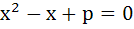 and γ, δ roots of and γ, δ roots of 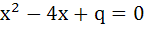 . If α, β, γ, δ are in geometric progression then the integral values of p and q respectively are . If α, β, γ, δ are in geometric progression then the integral values of p and q respectively are a) −2, −32 b) −2, 3 c) −6, 3 d) −6, −32
Let α, β be the roots of and γ, δ roots of . If α, β, γ, δ are in geometric progression then the integral values of p and q respectively are a) −2, −32 b) −2, 3 c) −6, 3 d) −6, −32
|
IIT 2001 |
05:16 min
|
|
505 |
For what values of k does the following system of equations possess a non-trivial solution over the set of rationals? Find all the solutions. x + y – 2z = 0 2x – 3y + z = 0 x – 5y + 4z = k
For what values of k does the following system of equations possess a non-trivial solution over the set of rationals? Find all the solutions. x + y – 2z = 0 2x – 3y + z = 0 x – 5y + 4z = k
|
IIT 1979 |
05:23 min
|
|
506 |
Prove that there exists no complex number z such that  and and  . .
Prove that there exists no complex number z such that and .
|
IIT 2003 |
04:27 min
|
|
507 |
Three normals with slopes  are drawn from a point P not on the axis of the parabola are drawn from a point P not on the axis of the parabola  . If . If  results in the locus of P being a part of the parabola, find the value of α. results in the locus of P being a part of the parabola, find the value of α.
|
IIT 2003 |
05:59 min
|
|
508 |
Find the value of the expression 1.(2−ω)(2− + 2.(3−ω)(3−+ … (n−1).(n−ω)(n− + 2.(3−ω)(3−+ … (n−1).(n−ω)(n− where ω is an imaginary cube root of unity. a)  n(n−1)( n(n−1)( +3n+4) +3n+4) b) n(n+1)(+3n+4) c) n(n−1)(+n+1) d) n(n+1)(+n+1)
|
IIT 1996 |
05:00 min
|
|
509 |
If 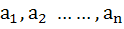 are positive real numbers whose product is a fixed number c then the minimum value of are positive real numbers whose product is a fixed number c then the minimum value of  is is a)  b) 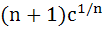 c)  d) 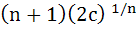
If are positive real numbers whose product is a fixed number c then the minimum value of is a) b) c) d)
|
IIT 2002 |
02:06 min
|
|
510 |
If three complex numbers are in arithmetic progression then they lie on a circle in the complex plane. a) True b) False
If three complex numbers are in arithmetic progression then they lie on a circle in the complex plane. a) True b) False
|
IIT 1985 |
01:13 min
|
|
511 |
A solution of the differential equation 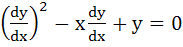 is is a) y = 2 b) y = 2x c)  d) 2
A solution of the differential equation is a) y = 2 b) y = 2x c) d) 2
|
IIT 1999 |
01:47 min
|
|
512 |
For all x,  then the interval in which a lies is then the interval in which a lies is a) a <  b) 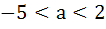 c)  d) 
For all x, then the interval in which a lies is a) a < b) c) d)
|
IIT 2004 |
01:45 min
|
|
513 |
Let the three digit numbers A28, 3B9 and 62C where A, B, C are integers between 0 and 9, be divisible by a fixed number k. Show that the determinant
 is divisible by k.
Let the three digit numbers A28, 3B9 and 62C where A, B, C are integers between 0 and 9, be divisible by a fixed number k. Show that the determinant
is divisible by k.
|
IIT 1990 |
04:45 min
|
|
514 |
If a and b are real numbers between 0 and 1 such that the points  form an equilateral triangle then a is equal to . . . . form an equilateral triangle then a is equal to . . . . a) 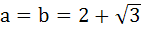 b) 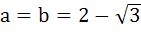 c) 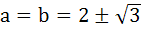 d) 
If a and b are real numbers between 0 and 1 such that the points form an equilateral triangle then a is equal to . . . . a) b) c) d)
|
IIT 1989 |
03:07 min
|
|
515 |
Let E be the ellipse  and C be the circle and C be the circle 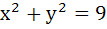 . Let P and Q be the points (1, 2) and (2, 1) respectively. Then . Let P and Q be the points (1, 2) and (2, 1) respectively. Then a) Q lies inside C but outside E b) Q lies outside both C and E c) P lies inside both C and E d) P lies inside C but outside E
Let E be the ellipse and C be the circle . Let P and Q be the points (1, 2) and (2, 1) respectively. Then a) Q lies inside C but outside E b) Q lies outside both C and E c) P lies inside both C and E d) P lies inside C but outside E
|
IIT 1994 |
04:15 min
|
|
516 |
Let a, b, c be the sides of a triangle where a ≠ c and λ ε R. If roots of the equation  are real then are real then a)  b)  c)  d) 
Let a, b, c be the sides of a triangle where a ≠ c and λ ε R. If roots of the equation are real then a) b) c) d)
|
IIT 2006 |
04:47 min
|
|
517 |
Find the value of the determinant
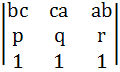 where a, b, c are respectively pth, qth and rth term of a harmonic progression. a) 0 b) 1 c) ½ d) None of the above
Find the value of the determinant
where a, b, c are respectively pth, qth and rth term of a harmonic progression. a) 0 b) 1 c) ½ d) None of the above
|
IIT 1997 |
04:23 min
|
|
518 |
If tangents are drawn to the ellipse 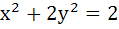 then the locus of the mid-points of the intercepts made by the tangents between the coordinate axes is then the locus of the mid-points of the intercepts made by the tangents between the coordinate axes is a) 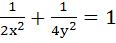 b) 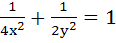 c)  d) 
If tangents are drawn to the ellipse then the locus of the mid-points of the intercepts made by the tangents between the coordinate axes is a) b) c) d)
|
IIT 2004 |
03:11 min
|
|
519 |
Let S is the set of all real x, such that  is positive, then S contains is positive, then S contains a)  b)  c)  d) 
Let S is the set of all real x, such that is positive, then S contains a) b) c) d)
|
IIT 1986 |
04:28 min
|
|
520 |
Let pλ4 + qλ3 + rλ2 + sλ + t = 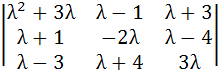 be an identity in λ where p, q, r, s, t are constants. Find the value of t. be an identity in λ where p, q, r, s, t are constants. Find the value of t. a) 0 b) +1 c) –1 d) ±1
Let pλ4 + qλ3 + rλ2 + sλ + t = be an identity in λ where p, q, r, s, t are constants. Find the value of t. a) 0 b) +1 c) –1 d) ±1
|
IIT 1981 |
02:38 min
|
|
521 |
The solution set of equation 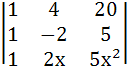 = 0 is ………. = 0 is ………. a) {0} b) {1, 2} c) {−1, 2} d) {−1, −2}
The solution set of equation = 0 is ………. a) {0} b) {1, 2} c) {−1, 2} d) {−1, −2}
|
IIT 1981 |
02:12 min
|
|
522 |
An ellipse has eccentricity  and one of the focus at the point and one of the focus at the point  It’s one directrix is the common tangent near to the point P to the circle It’s one directrix is the common tangent near to the point P to the circle 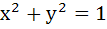 and the hyperbola and the hyperbola 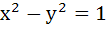 . Then the equation of the ellipse in the statement form is . . . . . . Then the equation of the ellipse in the statement form is . . . . .
|
IIT 1996 |
07:07 min
|
|
523 |
The equation  has has a) no real solutions b) one real solution c) two real solutions d) infinite real solutions
The equation has a) no real solutions b) one real solution c) two real solutions d) infinite real solutions
|
IIT 1982 |
03:09 min
|
|
524 |
For positive numbers x, y and z the numerical value of the determinant
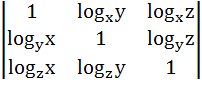 is ……….. is ……….. a) 1 b) –1 c) ±1 d) 0
For positive numbers x, y and z the numerical value of the determinant
is ……….. a) 1 b) –1 c) ±1 d) 0
|
IIT 1993 |
02:04 min
|
|
525 |
The equation  represents represents a) No locus if k > 0 b) An ellipse if k < 0 c) A point if k = 0 d) A hyperbola if k > 0
The equation represents a) No locus if k > 0 b) An ellipse if k < 0 c) A point if k = 0 d) A hyperbola if k > 0
|
IIT 1994 |
02:16 min
|